

In industrial process control and hydrological monitoring, selecting the right level measurement instrument is critical. A wrong choice can lead to frequent maintenance, inaccurate data, or premature equipment failure. Among various instruments, Capacitive Level Transmitters and Self-Contained Water Level Gauges are two widely discussed solutions.
While both are used to track liquid levels, they operate on completely different principles and serve distinct environments. In this article, we will break down their core differences to help you make the best choice for your project.
What is a Capacitive Level Transmitter?
A Capacitive Level Transmitter (often called a capacitive level gauge) relies on the electrical principle of capacitance.
How it Works: The sensor probe and the metallic container wall act as two plates of a capacitor, while the liquid between them serves as the dielectric medium. As the liquid level rises or falls, the total dielectric constant changes, causing a corresponding shift in capacitance. The built-in electronics convert this change into a standard linear signal (such as 4-20mA or RS485).
Key Advantages: Since it features no moving parts, it is highly durable and resistant to mechanical wear. It excels at measuring high-temperature, high-pressure, and highly corrosive or viscous liquids (such as acids, petroleum, and chemical blends) inside industrial process tanks.
What is a Self-Contained Water Level Gauge?
A Self-Contained Water Level Gauge (also known as an autonomous water level logger) is an independent, integrated device based on hydrostatic pressure measurement principles.
How it Works: When submerged in water, its high-precision pressure sensor detects the hydro-static pressure exerted by the liquid column above it. Simultaneously, an internal temperature sensor monitors the ambient water temperature to correct and compensate for density variations, ensuring extreme data accuracy.
Key Advantages: True to its name, it is completely “self-contained”. It features a built-in high-capacity battery and an internal data logger. It requires zero external wiring, zero external power, and can operate autonomously for several years on a single battery, making it perfect for remote or harsh open-field deployments.
Side-by-Side Technical Comparison
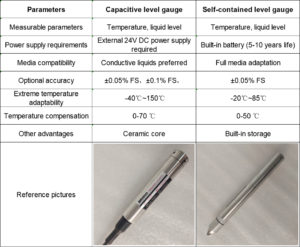
To get a clearer picture, let’s look at how these two technologies stack up across key technical specifications:
| Feature | Capacitive Level Transmitter | Self-Contained Water Level Gauge |
| Measurement Principle | Dielectric capacitance variation | Hydrostatic air/fluid pressure measurement |
| Power Supply | Must be externally powered (typically 24VDC) | Built-in battery (lasts up to several years) |
| Data & Output | Real-time continuous feedback (4-20mA, RS485, HART) | Internal logging; retrieved via data interfaces |
| Installation Method | Top-mounted on tanks via threads or flanges | Submersible / Anchor installation (dropped to the bottom) |
| Ideal Media | Industrial chemicals, oils, viscous fluids, slurries | Fresh water, sea water, groundwater, tidal zones |
| Main Environment | Factory storage tanks, processing plants | Oceans, rivers, lakes, observation wells, marine piers |
Application Selection Guide: Which One Do You Need?
Choose a Capacitive Level Transmitter if:
You need real-time automation integration: Your facility uses a centralized PLC, DCS, or SCADA system that requires immediate, real-time loop feedback to trigger valves or pumps.
The environment is harsh and confined: You are measuring liquids in enclosed tanks under high temperatures, high pressures, or dealing with highly corrosive industrial chemicals.
Choose a Self-Contained Water Level Gauge if:
There is no power infrastructure: You are deploying sensors in remote field hydrology sites, open rivers, reservoirs, or marine tidal monitoring stations where running power cables is impossible or too costly.
You focus on long-term data recording: Your primary goal is long-term environmental research, tidal observation, or groundwater level tracking, where data can be logged internally and downloaded periodically.
Easy, non-intrusive installation is required: You need a compact tool that can be quickly anchored to a pier, dock, or seabed without complex mounting brackets.
Conclusion
Capacitive and self-contained level gauges are not competitors; rather, they are optimized for entirely different worlds. Capacitive transmitters are the backbone of indoor industrial plant automation, while self-contained pressure gauges are the ultimate “set-and-forget” warriors for outdoor field hydrology and marine observation.
Need Professional Sourcing Advice?
At Besteetech, we specialize in high-precision industrial instrumentation, including water-conservancy transmitters, remote pressure loggers, and fluid control sensors. Contact our engineering team today to get a customized product consultation and robust sourcing solutions for your next project!