

In industrial pressure measurement, pressure sensors and pressure transmitters are widely used terms. Many buyers, engineers, and sales staff mix them up and treat them as the same product. Transmitters contain pressure sensing chips inside, but they differ greatly in structure, signal output, and application scenarios. Choosing the wrong one will cause unstable readings, signal loss over long cables, and failure to connect with PLC or DCS systems.
What is a Pressure Sensor
A pressure sensor is the sensitive element or sensing chip. Its only function is to convert physical pressure (gas or liquid pressure) into raw, weak electrical signals. Common types: diffused silicon piezoresistive, ceramic capacitive, piezoelectric, strain gauge. Typical output: mV signal, resistance change, or capacitance change. The raw signal is unamplified, without temperature compensation or linear correction. It cannot be transmitted over long distances and requires extra signal conditioning circuit boards.
Simply put: The sensor detects pressure and outputs raw weak signals.
What is a Pressure Transmitter
Pressure transmitter = pressure sensing chip + integrated signal conditioning circuit. Built-in amplifier, filter, temperature compensation, and linear calibration circuit convert the weak raw signal into standard industrial signals. Common outputs: 4-20mA, 0-10V / 1-5V. Smart versions support HART and RS485 Modbus. It can connect directly to PLCs, DCS, and data recorders and support stable long-distance transmission.
Simply put: A transmitter senses pressure and delivers processed standard signals to control systems.
Industry note: Some suppliers name amplified 0-5V modules “sensors”. Do not judge by name only; always check the output signal.
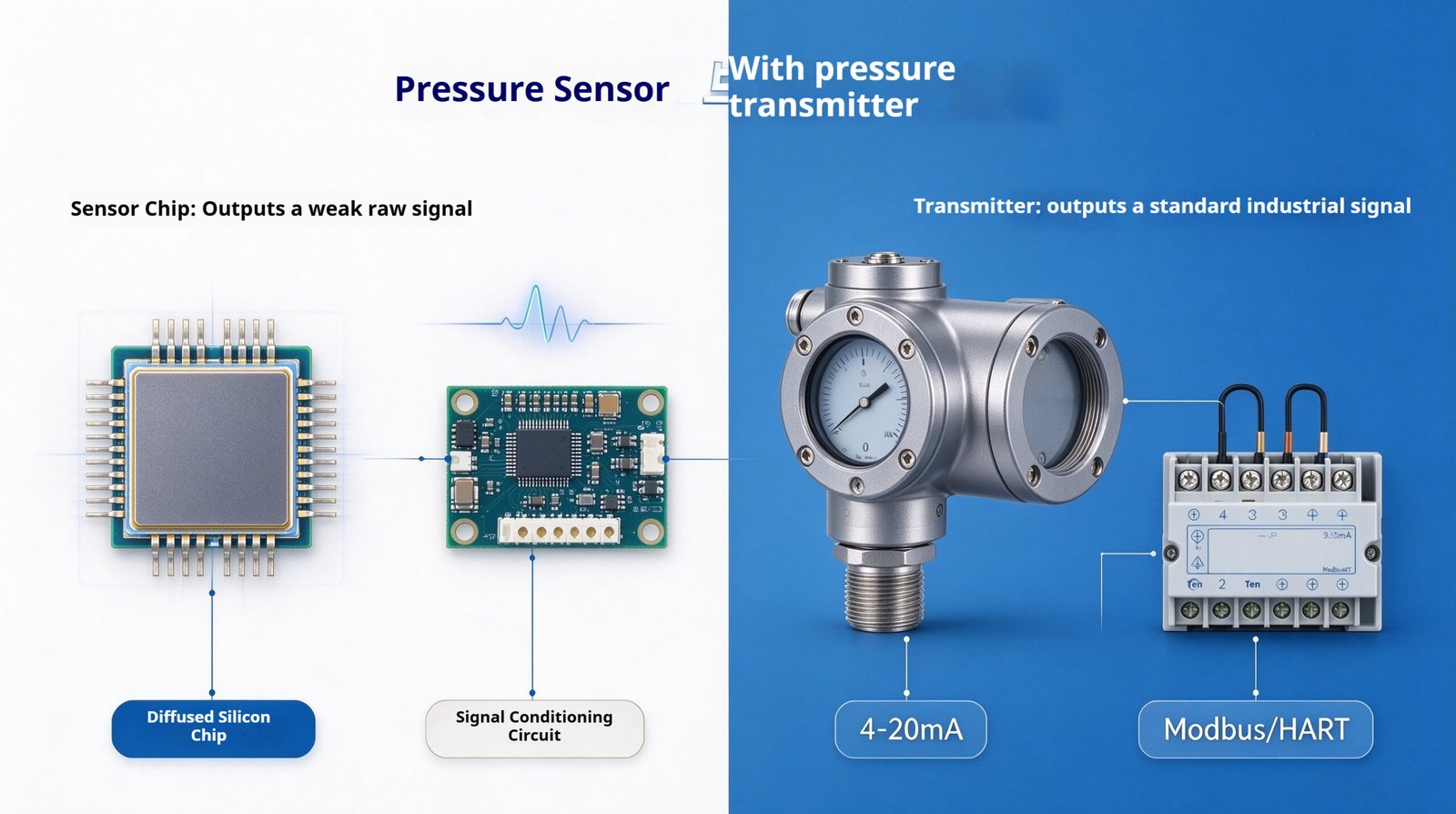
Comparison Table
| Item | Pressure Sensor | Pressure Transmitter |
| Components | Sensing chip only, no signal conditioning | Sensor chip + conditioning, compensation & calibration circuit |
| Output | mV, resistance, capacitance raw signal | 4-20mA, 0-10V, HART, Modbus standard signals |
| Signal stability | Easy to be affected by temperature and EMI; significant attenuation over long cables | Compensated and calibrated, strong anti-interference |
| System connection | Cannot connect PLC directly; extra circuit needed | Directly compatible with industrial control systems |
| Installation | OEM embedded for equipment internal use | Independent field instrument, threaded or flange mounting |
| Protection | Bare chip or small PCB, low IP rating | Industrial housing, optional waterproof, dustproof, and explosion-proof |
| Accuracy | Chip accuracy depends on external circuit | Factory-calibrated overall accuracy such as 0.25%FS, 0.5%FS |
How They Work Together
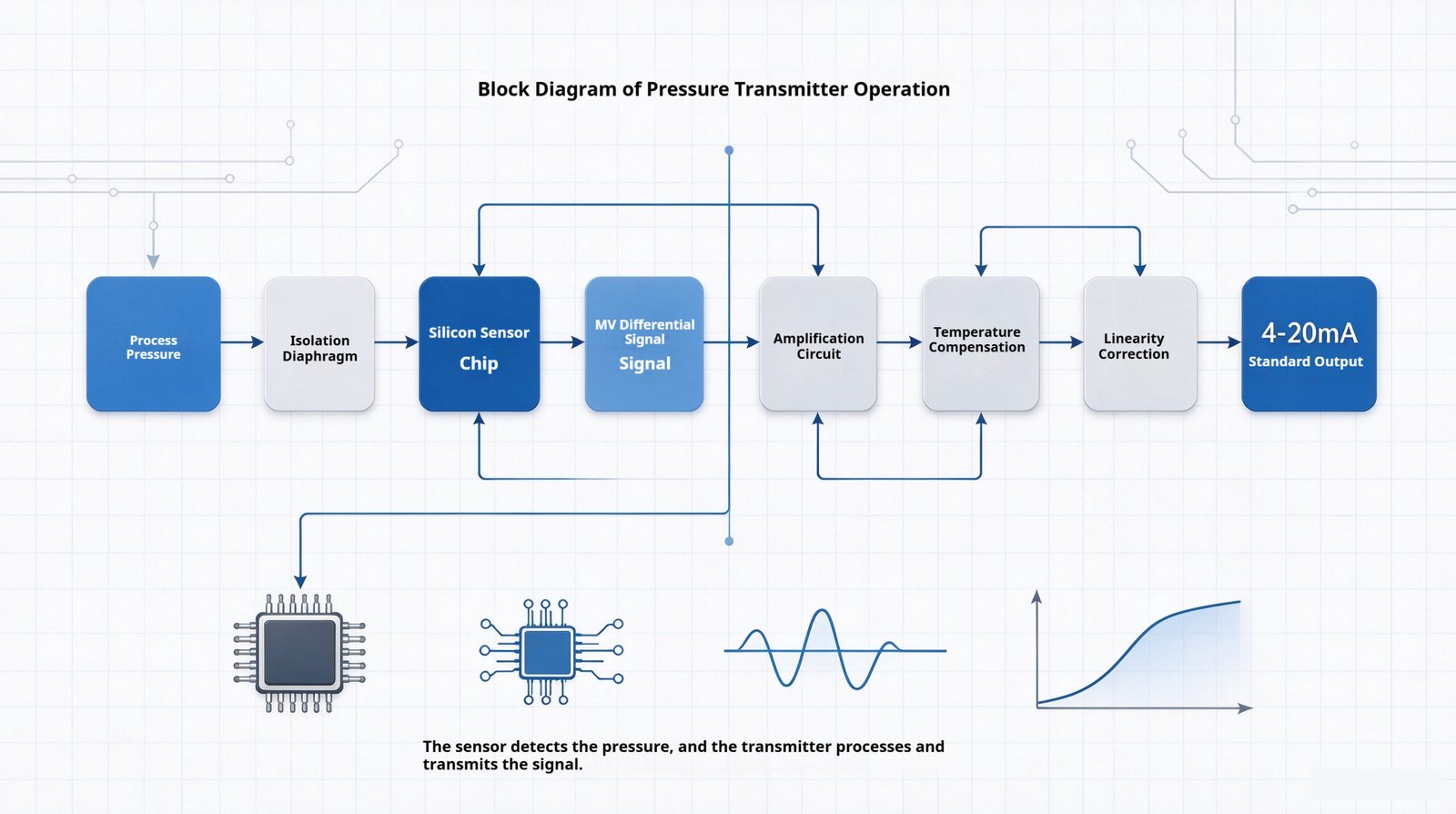
Take a diffused silicon piezoresistive type as an example. Pressure pushes the isolation diaphragm and transfers pressure to the silicon chip. The Wheatstone bridge on the chip changes resistance and outputs a mV differential signal — this is the pressure sensor. The mV signal goes into the transmitter PCB for amplification, filtering, temperature drift compensation, and linear correction, then converted to 4-20mA — this extra process is what the transmitter does.
Conclusion: The transmitter includes a pressure sensor as its core sensing part.
When to Choose a Pressure Sensor
- OEM equipment development: air compressors, water treatment, medical devices, home appliances with your own main board;
- Short-distance on-board acquisition, PCB mounting;
- Mass-produced built-in parts for cost control;
- Secondary development based on raw signal.
When to Choose a Pressure Transmitter
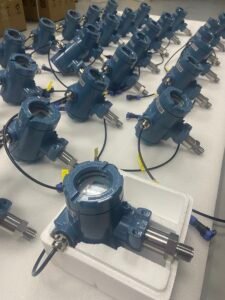
- Factory automation, chemical, water, oil & gas, hydraulic on-site control with PLC/DCS;
- Long signal cables, high anti-interference requirement;
- Direct field installation without extra circuit design;
- Explosion-proof, anti-corrosion, local display, HART configuration and remote monitoring;
- EPC projects, control cabinet integration.
Common Misunderstandings
- ❌ Transmitters are always more accurate than sensors ✅ The sensing chip itself has its accuracy grade. Transmitters gain better performance through overall temperature and linear compensation. A good bare sensor will still read poorly without proper signal processing.
- ❌ Voltage output = sensor, 4-20mA = transmitter ✅ Naming rules vary among manufacturers. The key standard is whether it has complete built-in signal conditioning and standard industrial output.
- ❌ If you have a sensor, you don’t need a transmitter ✅ Raw mV signals cannot be read reliably by a PLC directly without conditioning modules.
Summary
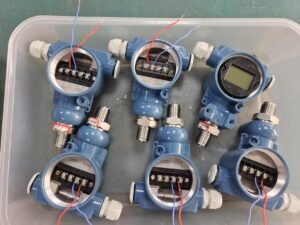
A pressure sensor is the sensitive core that captures pressure and outputs raw signals, mainly for OEM integration. A pressure transmitter is a complete measuring instrument with a built-in sensor and signal processing unit, outputting standard industrial signals for field automation.
BESTEE provides pressure-measuring solutions tailored to your OEM or site automation requirements to prevent incorrect selection.