

Introduction
Accurate, non-contact water velocity measurement is vital for hydrological monitoring, open-channel irrigation, wastewater management, and flood warning systems. Traditional contact-based flow meters often fail during high-flow conditions or in sediment-rich, debris-heavy environments.
Non-contact 24GHz radar velocity meters offer a reliable, maintenance-free solution by emitting microwave signals to sense surface water velocity without touching the medium.
When choosing between the BT7320 and BT7350 radar velocity meters, the primary decision comes down to your installation requirement: Do you need a portable, handheld device for flexible field spot-checks, or a fixed, low-power continuous sensor for automated monitoring stations?
This guide provides a detailed technical comparison to help you choose the ideal radar flow meter for your application.
Technical Feature Overview
Below is a quick comparison matrix outlining the core specifications of both models:
| Key Specifications | BT7320 (Handheld Radar) | BT7350 (Fixed Station Radar) |
| Primary Form Factor | Compact Handheld (470g) | Compact Box Enclosure (100*100*40 mm) |
| Radar Technology | 24 GHz Planar Array (12° × 25°) | German InnoSenT 24 GHz Planar Microstrip |
| Effective Distance | Up to 100 meters | 0.5 to 30 meters |
| Velocity Range | 0.05-30 m/s | 0.15-15 m/s |
| Velocity Accuracy | ±0.01%, 1% F.S | ±0.02% F.S |
| Protection Rating | IP68 (Full Submersion Waterproof) | IP66 (Dust-proof & Rainproof Enclosure) |
| Power Supply | Dual-Mode: 8000 mAh Rechargeable Li-ion + Dry Battery Backup | 7 – 28 V DC External Power |
| Data & Interfaces | Custom LCD Display, 1000+ Internal Logs, Bluetooth | RS-232, RS-485, SDI-12, 4–20 mA Current Loop |
| Angle Compensation | Automatic Vertical (30-70℃) + Manual Horizontal | Fixed Mounting Angle (30- 60℃) |
In-Depth Comparison: Key Differentiators
1. Mobility & Operation Mode
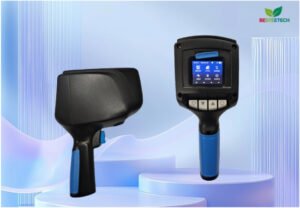
BT7320: Engineered for field mobility and rapid response. Weighing just 470g, field technicians can easily carry it, aim at the water body, and get instant readings on the built-in LCD screen. Integrated Bluetooth and memory logging allow users to store over 1,000 measurements without additional cabling.
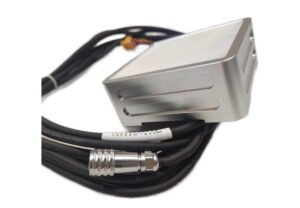
BT7350: Designed for fixed, long-term, unmanned installations. It mounts securely onto bridges, crossbeams, or cantilever arms, seamlessly connecting to remote telemetry units (RTUs), PLCs, or data loggers via standard industrial protocols (RS-485 / 4–20 mA).
2. Measuring Distance & Velocity Range
BT7320: Features an exceptional 100-meter range and a wide velocity detection scope ($0.05-30 m/s). This long reach allows operators to stand safely on high riverbanks or bridge structures during severe flood events without approaching hazardous water currents.
BT7350: Provides a focused 0.5 to 30-meter range with velocity coverage of 0.15-15 m/s. It focuses on high measurement stability and continuous data stream consistency for daily hydrological tracking.
3. Power Management Strategy
BT7320 (Dual Power Reliability): Equipped with an internal 8000 mAh rechargeable lithium battery offering up to 9 hours of continuous operation or 26 hours of standby. Crucially, it supports emergency dry battery operation—ensuring field crews are never left stranded with a dead battery in remote areas.
BT7350 (Ultra-Low Solar/DC Standby): Draws power from local DC sources or solar power systems (7 – 28 V DC). In standby mode, power consumption drops to ≤1 mA, making it perfect for off-grid, solar-powered monitoring stations.
4. Ruggedness & Environmental Protection
BT7320: Rated IP68, giving it maximum protection against dust, torrential downpours, mud, and accidental water immersion in harsh outdoor environments.
BT7350: Rated IP66, utilizing an aluminum alloy back cover and POM front cover that reliably withstands severe sunlight, UV exposure, and heavy rain during long-term outdoor exposure (-40~ +60℃).
Which Radar Velocity Meter Should You Choose?
Do you need continuous, automated monitoring?
/ \
YES NO
/ \
BT7350 (Fixed Radar) BT7320 (Handheld Radar)
– Continuous telemetry – Field surveys & spot-checks
– RS-485 / SDI-12 / 4-20mA – 100m long range & IP68
– Low-power solar standby – Emergency battery backup
Choose the BT7320 (Handheld) if you:
Conduct periodic hydrological surveys across multiple rivers, lakes, or coastal zones.
Need a safety-first solution for emergency flood measurements from long distances (up to 100 meters).
Manage wastewater treatment networks, underground culverts, and sewer lines where portable spot-checking is required.
Require immediate visual readouts on an LCD screen and wireless data export via Bluetooth.
Choose the BT7350 (Fixed) if you:
Build permanent hydrological stations, automated irrigation canal systems, or smart city drainage networks.
Require integration with external data loggers, SCADA systems, or RTUs using RS-485, SDI-12, or 4–20 mA interfaces.
Need low power consumption ($\le 1\text{ mA}$ standby) for continuous solar-powered telemetry.
Require reliable German InnoSenT 24GHz hardware performance for permanent outdoor installations.
Conclusion & Next Steps
Both the BT7320 and BT7350 leverage advanced 24GHz radar technology to overcome the vulnerabilities of traditional contact flow meters. Selecting the right model depends on whether your project requires handheld versatility for field technicians or fixed continuous automation for smart telemetry networks.
Need technical assistance or custom configuration for your project?
Our engineering team provides comprehensive support for industrial flow measurement and telemetry integration.
👉 [Contact Us Today to Request a Quote or Technical Datasheets]