Author name: admin

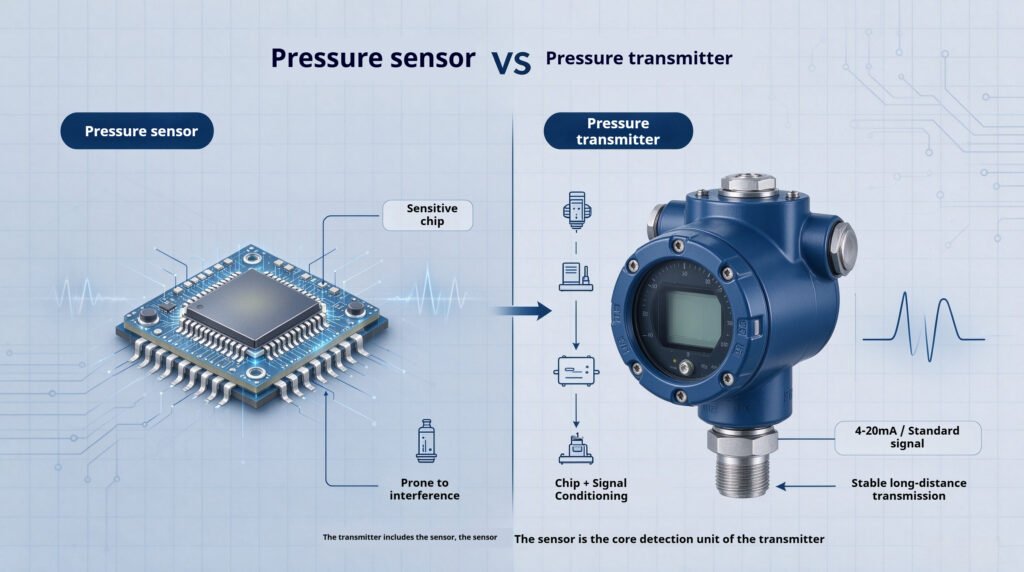
Pressure Sensor vs Pressure Transmitter: What Is The Difference?

In industrial pressure measurement, pressure sensors and pressure transmitters are widely used terms. Many buyers, engineers, and sales staff mix them up and treat them as the same product. Transmitters contain pressure sensing chips inside, but they differ greatly in structure, signal output, and application scenarios. Choosing the wrong one will cause unstable readings, signal […]

Pressure Sensor vs Pressure Transmitter: What Is The Difference? Read More »
Radar Level Gauge Working Principle, Types & Installation Guide

Radar Level Gauge Working Principle, Types & Installation Guide

Introduction Radar level gauges are a type of universal radar level meter. They are measurement instruments based on the time-of-flight principle. Radar waves travel at the speed of light, and electronic components convert the travel time into a level signal. The probe emits high-frequency pulses that propagate in space at the speed of light. When

Radar Level Gauge Working Principle, Types & Installation Guide Read More »

Radar Flow Meter Selection Guide:

Radar Flow Meter Selection Guide: BT7320 vs. BT7350 – Which One Suits Your Project?

Introduction Accurate, non-contact water velocity measurement is vital for hydrological monitoring, open-channel irrigation, wastewater management, and flood warning systems. Traditional contact-based flow meters often fail during high-flow conditions or in sediment-rich, debris-heavy environments. Non-contact 24GHz radar velocity meters offer a reliable, maintenance-free solution by emitting microwave signals to sense surface water velocity without touching the medium.

Radar Flow Meter Selection Guide: BT7320 vs. BT7350 – Which One Suits Your Project? Read More »

10 Tips for Selecting Industrial Automation Sensors

Excerpt: In modern industrial automation systems, sensors play a crucial role in monitoring and controlling process parameters. Discover 10 practical tips for selecting the right industrial automation sensors to optimize system performance, ensure accuracy, and lower operating costs. In modern industrial automation systems, sensors play a crucial role. They monitor and control various parameters in

10 Tips for Selecting Industrial Automation Sensors Read More »

The 5 Advantages Of Ceramic Core Body Level Transmitter

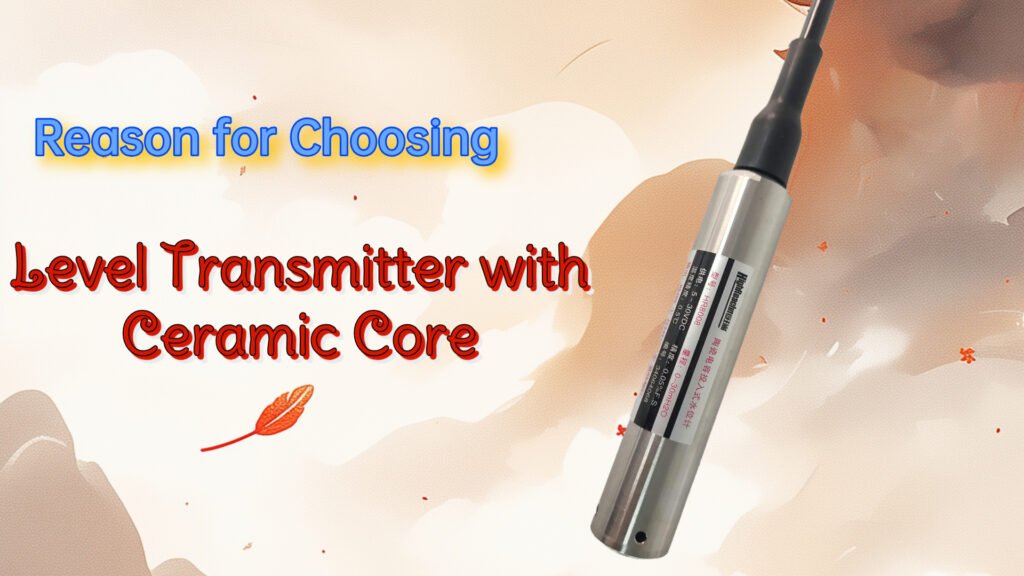
Unveiling The 5 Advantages Of Ceramic Core Body Level Transmitter

Click here to check more details of the BT8008 ceramic-core level transmitter. In the industrial production process, liquid level measurement is a crucial link. A liquid level transmitter with excellent performance can not only improve production efficiency but also ensure production safety. In recent years, ceramic core level transmitters have stood out in the market

Unveiling The 5 Advantages Of Ceramic Core Body Level Transmitter Read More »

Temperature chain installation complete.

Multi-Depth Water Temperature Chain Installation: A Step-by-Step Hydrological Case Study

Continuous and accurate underwater temperature profiling is crucial for analyzing aquatic ecosystems, reservoir stratification, and hydrological dynamics. Recently, the Besteetech engineering team successfully deployed an autonomous, solar-powered Multi-Depth Water Temperature Chain System featuring submerged probe arrays ranging from 40 to 55 meters. Equipped with real-time wireless telemetry and a customized floating island platform, this system enables seamless,

Multi-Depth Water Temperature Chain Installation: A Step-by-Step Hydrological Case Study Read More »

Capacitive vs. Self-Contained Water Level Gauges: Key Differences and Application Guide

In industrial process control and hydrological monitoring, selecting the right level measurement instrument is critical. A wrong choice can lead to frequent maintenance, inaccurate data, or premature equipment failure. Among various instruments, Capacitive Level Transmitters and Self-Contained Water Level Gauges are two widely discussed solutions. While both are used to track liquid levels, they operate on completely

Capacitive vs. Self-Contained Water Level Gauges: Key Differences and Application Guide Read More »

How to Maintain Hydraulic Torque Wrenches

How to Maintain Hydraulic Torque Wrenches: 4 Essential Maintenance Tips

In modern industrial maintenance and heavy assembly, hydraulic torque wrenches have become indispensable tools. They not only boost operational efficiency but also minimize physical fatigue and human error during high-torque bolting. However, like any precision hydraulic equipment, their longevity depends heavily on proper operation and routine care. Here are essential maintenance best practices to effectively

How to Maintain Hydraulic Torque Wrenches: 4 Essential Maintenance Tips Read More »

Unlock the Precision and Efficiency of Level Measurement with Radar Technology

What You Need to Know About Radar Level Gauges

Radar level gauges belong to the category of universal radar level meters. They are measurement instruments based on the time-of-flight principle. Radar waves travel at the speed of light, and the travel time can be converted into a level signal through electronic components. The probe emits high-frequency pulses that propagate in space at the speed

What You Need to Know About Radar Level Gauges Read More »

High-Precision Self-Contained Water Level Gauge for Long-Term Monitoring

High-Precision Self-Contained Water Level Gauge for Long-Term Monitoring

The self-contained water level gauge is a water level recording device based on the principle of pressure measurement. Here is a detailed introduction to it:   Working Principle The working principle of the self-contained water level gauge is to measure the water level height using changes in air pressure signals within the pipeline. When the

High-Precision Self-Contained Water Level Gauge for Long-Term Monitoring Read More »